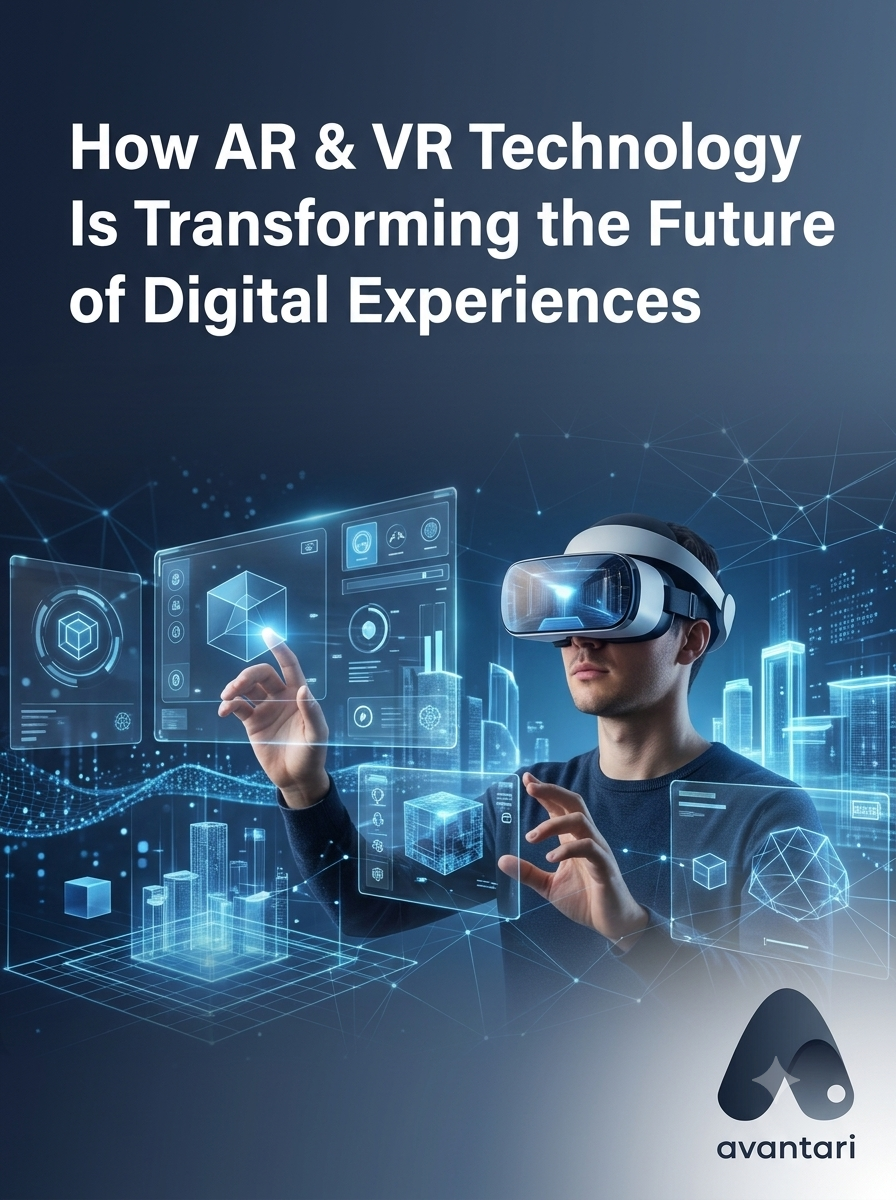
Technology is always evolving and changing the way we interact with platforms, products and services. Augmented Reality (AR) & Virtual Reality (VR) are some of the most exciting technologies that can be used to add new features and functionality to businesses. These can be used for virtual shopping, interactive learning, training in healthcare and much more.
Traditionally digital experiences are done via images and text. With AR & VR you can go into digital environments, view products in real life and have more interactive experiences. Businesses are looking at new and innovative ways to use digital technology and AR VR app development is an exciting area of technology.
What is Augmented Reality & Virtual Reality?
AR & VR can often be confused but offer different digital experiences.
Augmented Reality (AR) adds digital elements to a real-life environment. You can view virtual items, animations and information on your smartphone, tablet or AR enabled devices.
For example customers can view what furniture would look like in their living room using an AR application.
Virtual Reality (VR) creates a fully digital environment. Using VR Headsets and compatible devices people can engage with virtual environments, training and much more.
Both technologies offer businesses some exciting opportunities.
1.Changing the Retail & Ecommerce Industry
Within the retail industry AR & VR are changing the way people interact with products. Many people struggle to understand what products actually look like, the size and if they will suit them from just viewing photos.
AR applications help by allowing customers to view products in their surroundings. For example customers can try on clothes virtually, see how furniture would fit and experiment with cosmetics.
VR can also be used for virtual showrooms so customers can view products.
By offering these experiences customers can make more informed decisions when purchasing products. Businesses can also improve their customer satisfaction with these technologies.
- Interactive Learning
AR & VR are helping to transform the education industry. Sometimes complex topics can be confusing when taught traditionally.
AR applications can be used to show interactive 3D models of the human body, science, historical places and engineering. This can be viewed from all angles so students can understand how each part works.
With VR businesses can create virtual classrooms, lab training and interactive learning. Students can experience historical events, geographical places or learn technical skills.
This makes learning more interactive and gives educational institutions extra ways to help learners.
- Helping in Healthcare
Healthcare organisations are looking at using AR & VR to help train medical professionals and improve patient experiences.
VR can be used to create simulations so medical students and healthcare professionals can learn how to perform procedures. This can help train people without using real patients straight away.
AR can be used to help medical professionals by showing digital information and guidance during certain procedures. Patients can also benefit as they can understand their condition better.
VR can also be used to help with pain management, rehabilitation and mental health. This can depend on the application and correct supervision.
- Transforming the Property & Architectural Industry
AR & VR are changing how people view properties.
Using VR applications potential buyers can take virtual tours of the property, see how the rooms would look and view building designs. This can be helpful for customers who aren’t able to visit.
AR applications can be used by architects, designers and clients to view digital models of buildings in real life. They can see how furniture would fit, what the interior would look like and see the buildings structure.
This can help improve communication between professionals and clients and reduce confusion.
- Increasing Gaming & Entertainment
AR & VR are some of the most well known uses of these technologies.
AR games can be played by using digital characters and items within real life. VR games offer fully immersive experiences where players can explore virtual worlds and interact with objects using motion controls.
Immersive technology is also making an impact within live entertainment, virtual events, digital exhibitions and interactive stories.
As hardware becomes more accessible and development improves, entertainment will become more personal and interactive.
- Helping with Manufacturing
AR & VR are providing exciting opportunities within the manufacturing industry.
VR can be used to create simulations so staff can learn how to operate machinery, understand complex processes and complete safety training.
AR can help technicians by providing visual guidance, information about equipment and maintenance.
Businesses can also use immersive technology to review product designs, look at manufacturing processes and spot any issues.
This can help train staff and improve efficiency. It can also help make complex information easier to understand.
- Importance of AR VR App Development
As immersive technology becomes more popular businesses will want to create functional, easy to use, high performing and engaging apps.
Professional AR VR app development requires careful planning to ensure the correct technology is used. The app should be easy to use with intuitive interfaces, 3D modelling compatibility with devices and fully tested.
Depending on the project developers may use Unity, Unreal Engine, AR Kit, AR Core and Web XR.
Things to consider when developing:
- Easy to use
Apps should be easy to navigate
- High performance
Smooth visuals and responsiveness
- Compatibility
Make sure they can be used with the intended devices (smartphones, tablets, headset etc.)
- Security
Handle users information and permissions correctly
- Scalable
The app should be built to allow improvements in the future
Careful planning will help businesses create solutions that will really help users.
- What does the Future Hold?
The future of immersive technology will be closely linked to technologies like artificial intelligence, spatial computing, computer vision, cloud computing and wearable tech.
AI can be used to create more responsive AR & VR applications. This can include intelligent virtual assistants and personalised experiences.
Advancements in wearable tech may make immersive experiences more comfortable and convenient. Improvements in connectivity can help create more responsive applications.
Businesses will look to create new opportunities with immersive technology. This could include virtual collaboration, digital shopping, education, healthcare, entertainment and automation.
However they will need to overcome issues like cost of hardware, accessibility, data security and performance.
Conclusion
AR & VR are changing the way digital experiences work. By linking the real world to the digital world they can be used across many industries to create new opportunities for businesses. They can help to improve customer engagement, simplify complex processes and create interactive services.
As technology continues to evolve it will become increasingly important to invest in the correct development strategy. Businesses who understand their user needs and implement immersive technologies can create more meaningful digital experiences.
As development continues AR VR app development will play an important role in the future of digital transformation.
FAQs (frequently asked question)
- What is AR VR app development?
AR VR app development is the creation of applications that use Augmented Reality & Virtual Reality to provide interactive and immersive digital experiences. These can be created for smartphones, tablets, computers and headsets.
- What is the difference between AR & VR?
AR adds digital elements to the real world. VR creates a fully simulated digital environment. AR will enhance what you can see whilst VR will let you experience a fully virtual space.
- What industries can benefit from AR & VR?
Many industries can benefit such as healthcare, education, retail, property, manufacturing, gaming, tourism and entertainment.
- What technologies can be used for AR & VR?
Technologies commonly used include Unity, Unreal Engine, AR Kit, AR Core, Web XR and 3D modelling software. This will depend on the purpose of the application, what devices it will be used on and what the requirements are.
- How can AR & VR increase customer engagement?
AR & VR can increase engagement as they can provide interactive demonstrations, virtual tours, immersive storytelling and personalised experiences. Customers can view products in a more engaging way.
- Can small businesses use AR & VR?
Yes! Small businesses can use AR & VR depending on their budget and aims. A furniture store could add AR to allow customers to view products and a training company could create specific VR learning.